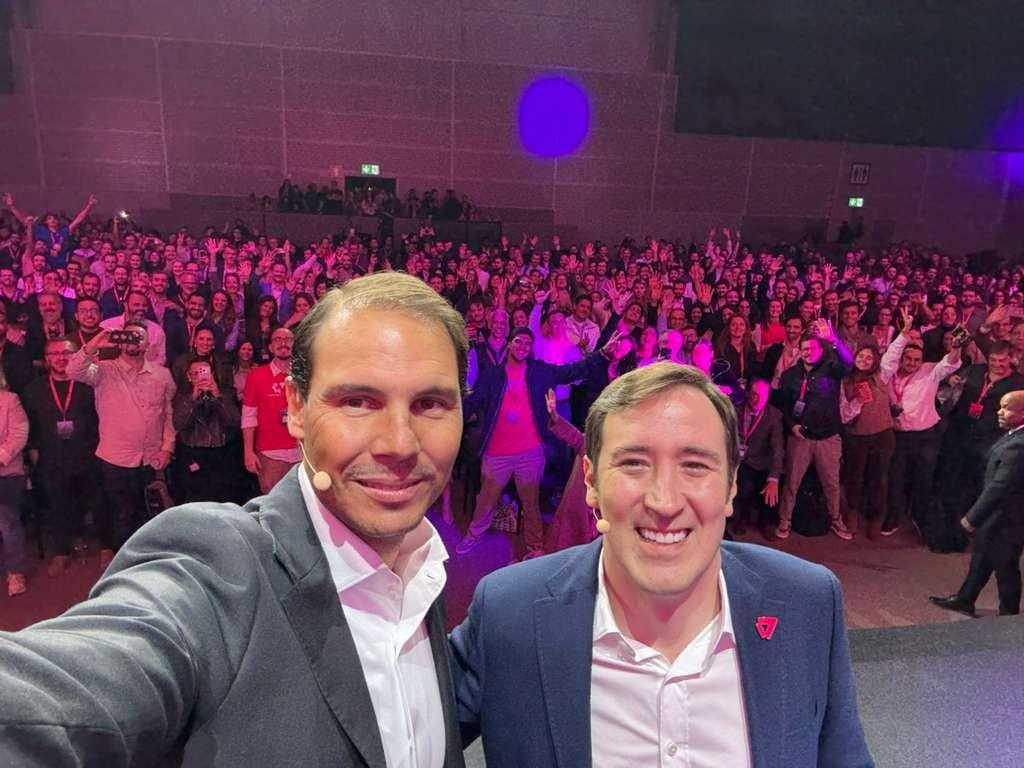
There are moments in life when a conversation does more than inspire; it recalibrates you.
That’s what happened to me in Lisbon during my interview with Rafa Nadal at VTEX Connect.
No cameras. No media pressure. Just a room of 2,500 leaders, and one of the greatest athletes of all time, speaking with a humility that almost disarms you.
Nadal walks into a room the same way he walks onto a court: fully present, intensely focused, and deeply respectful of everyone around him.
He doesn’t perform humility; he lives it. And that makes every word land differently.
During our conversation, a few ideas stayed with me long after the stage lights went off:
“I learned to suffer. That’s why I succeeded.”
When he said this, the room went silent.
He wasn’t glorifying pain. He was describing a mindset built over years: the discipline to show up relentlessly, the ability to stay composed when things don't go your way, and the courage to keep fighting until momentum returns.
It reminded me that leadership isn’t about avoiding difficult moments. It’s about absorbing them with clarity and moving forward anyway.
“You don’t win because you feel good. You win because you do the right things.”
Coming from someone with 22 Grand Slams reframes the concept of success. It isn’t emotional. It’s procedural. Supported by decades of discipline. Watching him hit with precision, even in casual rallies on stage, makes that lesson impossible to ignore.
“You can have intensity without breaking rackets.”
This one hit deeply: intensity without ego, competitiveness without chaos, ambition with respect. The closer you are to Nadal, the more obvious it becomes: his real strength isn’t his forehand, it’s his character.
“Even when I lost that match, I saw the bottle half-full.”
Nadal described a heartbreaking defeat, yet saw the bottle "almost complete." The reason? He knew he was ready to compete at the highest level again. Loss is feedback, not finality.
“Excuses don’t help you to be better.”
For him, losing isn't failure, it’s information. While feedback fuels progress, excuses paralyze it. Rafa never blamed his team or injuries; he adjusted, improved, and got back to work.
“Every practice is an opportunity.”
He never understood training “for the sake of practice”. For him, every practice is an opportunity to improve, to go onto the court with the mentality and the goal of enhancing something.
“Rivals make you better.”
Federer, Djokovic, and Nadal, competition fueled by admiration, not envy. Pushing each other to the limits to try to get better and better. They didn't compete to win simply; they competed to be pushed.
“The real victory is leaving people better than you found them.”
He shared this quietly, almost as a personal compass. In a world obsessed with trophies, it felt revolutionary. Greatness is not measured only by what you achieve…but by the impact you leave on those around you.
But the moment I’ll never forget wasn’t just the dialogue.
It was standing beside him on stage, hitting tennis balls with Nadal in front of thousands of people.
A surreal combination of pressure, adrenaline, and joy. And yet, even in that chaos, he radiated calm.
Greatness feels effortless only because it’s supported by decades of discipline.
Some conversations don’t just inspire you.
They sharpen you.
They remind you of the type of impact that truly matters.
Not louder.
Just truer.


![Digital Commerce: Definition, Benefits and Trends [GUIDE]](/images/blog/en-us/ouaokzfxqfoilcac.jpg)